Wednesday, 6 March 2013

West Ham United F.C. - "I'm Forever Blowing Bubbles"

Besides Liverpool, there is perhaps only one other club that can even claim to have the greatest traditional club song. That is, of course, West Ham United with "I'm Forever Blowing Bubbles", quite simply a national anthem for East London.

(Photo from Wallcoo)


Created in 1918, the song has a fascinating musical history, irrespective of the football connection. Written by John Kellette and 'Jaan Kenbrovin' (a collective pseudonym for a trio of writers), the track made it's first public appearance in the Broadway musical The Passing Show Of 1918. Copyright for the song was finally registered in 1919 and, since then, it has been performed and recorded by a huge number of artists, including many influential musicians. The first to have success with it was Ben Selvin's Novelty Orchestra late in the year, followed closely by The Original Dixieland Jass Band, the latter performing it in a style that can only be described as an early form of jazz. It soon became extremely popular in Britain's music halls and theatres in the early 1920's, Dorothy Ward arguably the most influential in this movement.


It's transition into sport, however, is still a bit of a mystery. There are 3 main theories that club historians argue over, all of which I will explain below.

The first involves a famous painting, an advert for soap and a young West Ham player called Will Murray. In 1886, artist Sir John Everett Millais painted a portrait of his five year old grandson watching a soap bubble he had just blown. The painting was hugely successful and it soon found it's way into the hands of Thomas J. Barratt, managing director of A&F Pears. He later used it to advertise a product called Pears Soap, the advert became known simply as 'Bubbles'. 

 'Bubbles': The advert in question
(photo from City Room)


The next step of the story is where the controversy lies. Many believe the West Ham squad saw the poster and nicknamed youth player Will Murray 'Bubbles', mainly because he resembled the child featured on it. The fans got wind of this and, every time Murray played, they sang "I'm Forever Blowing Bubbles", in the charts at the time. Another version of the story claims Murray got the nickname 'Bubbles' from his headmaster Cornelius Beal, who knew the West Ham manager Charlie Paynter.
Unfortunately, this story was later proved to be false. Photos of Murray taken at the time show he looks absolutely nothing like the child in the advert. Secondly, club records show he never actually played in the senior squad, only the youth squad. While these facts don't make the myth impossible, it does raise the question, "would fans sing a song about a youth player they've probably never seen?" The answer is probably not.

The second theory stems from an FA Cup tie against Swansea City in 1922. Unlike West Ham, Swansea City have records to show that they definitely did sing "I'm Forever Blowing Bubbles" around this time during the majority of their home games. It has been speculated that West Ham effectively "borrowed" this tradition after the game against them and later made it their own.

 Vetch Field: Swansea City's home ground at the time
(photo from World Stadia)


The third and final theory is arguably the most plausible, although it does claim that the singing of the song did not start until 20 years later, during the time of the Second World War. At the time, it has been well documented that the song was sung in East End air raid shelters to raise spirits. This led to a rise in public communal singing, including at football matches. The tradition has carried on since then and has become one of the most loved songs in modern football.


It's now time to listen to the song to see what makes it a classic football anthem.


As with every song I cover, I headed on over to a fans' forum to get their opinion. This time, I went to the WestHamFans forum, where I got an overwhelming response.

Claire (44), from the Republic Of Ireland, said, "It never fails to bring a tear to my eye or a lump to my throat. On the rare occasion I'm in the ground and I hear it, it feels like I'm back home."

Darren (20), from London, said, "The best memories are of away matches. Once we start singing the first chorus, it's like "That's right. West Ham have arrived!""

John (34), from Lincoln, explains what it reminds him of. "My grandparents' house used to be a stone's throw away from the ground and whenever I hear the song, it takes me back to happier times when me and my brother used to play footie in their garden."

Ray (49), from East London, recalls one of his memories of the song, slightly reminiscent of the film Green Street, it must be said. "It reminds me of my first away trip to Old Trafford. In the back streets of Manchester, we were confronted by a gang of Mancs ready to kick the s**t out of us and then we hear the song. Our boys had arrived and the Mancs scarpered. It's a battle cry to me for that reason."


Thanks to all the participants for their opinions and interesting stories! I'll be back soon with another classic football song!

Sunday, 3 March 2013

Liverpool F.C. - "You'll Never Walk Alone"

Liverpool F.C. is easily one of the most famous clubs in world football. With a history that encapsulates both glory and tragedy, it's only fitting for them to have one of the greatest and most recognisable club songs in modern times. That song is of course "You'll Never Walk Alone", an uplifting anthem that has become synonymous with the Merseyside club and their fiercely loyal fanbase.

(Photo from Premier League Critic)


As with many traditional football songs, it had a very different beginning. Oddly enough, the song was originally written as a show tune. Featuring in the 1945 Rodgers and Hammerstein musical Carousel, the song is sung by a character called Nettie Fowler to comfort her recently widowed cousin. It is again performed in the final scene to celebrate a class graduation, just going to show the range of emotions that the track can cover.

It began it's transition towards the terraces following a cover of the song by Merseybeat band Gerry & The Pacemakers. Released in October 1963, it peaked at number 1 in the UK singles chart, eventually staying there for four consecutive weeks.

 Gerry & The Pacemakers
(photo from Hump Day Rock Music)


 At the time, the resident DJ at Anfield stadium (the team's ground) would play the radio's Top 10 chart before games to warm up the crowd. However, when "You'll Never Walk Alone" was played at number 1, something bizarre began to happen soon after. Fans began to sing the song themselves, which wasn't unusual in itself, apart from the fact that they did this long after it left the charts.

Since then, it has been sung before every home game and on several other occasions, whether the team are winning or losing. It has also become somewhat of a slogan for the club, featuring on their crest and also adorning the famous Shankly gates.

 The Shankly gates
(photo from LIverweb)


Despite being timeless in the football world, it has also recently made a re-entry into the Singles Charts. Following an online campaign by Liverpool fans in September 2012 to raise awareness of the tragic Hillsborough accident, the track entered the charts at number 12, selling 28,000 copies in just 24 hours.


Now let's have a listen to the song, complete with the original video.


Now it's time to get the fans' opinions once more, which I collected from the LFCReds fan forum. Due to the fanbase questioned and also the nature of the song, I was almost certain there would be no negativity whatsoever.

Neil (40), from Plymouth, said, "It always brings a lump to my throat and gives me goosepimples. In a kind of perverse way, I especially love it when we're losing and the fans still sing it."

Jackson (20), from Warrington, explained the effect it had on fans. "When I've seen games, both on TV and at Anfield, I've seen it reduce grown men to tears. It always brings a tear to my eye too. It's that emotional."

Gary (25), from Kent, spoke about what the song means to him. "When I hear it, it's split into both happy and sad thoughts. It reminds me of the joys of Istanbul (Champions League victory) and the '01 treble season, but also brings to mind the tragedies of Hillsborough, the Heysel stadium disaster and even the Munich air disaster."

Clint (52), from Manchester, went one step further. "To me, it's like The Bible for Christians, The Qur'an for Muslims and science for atheists. It's our religion and we go to it when we feel low. It gives us pride and joy."


From this, it's clear to see exactly what "You'll Never Walk Alone" means to the club and their fans. It's not just a song. It's a religion and a way of life.


Thanks for reading and to all those who gave their opinions! I'll be back soon to explore some more of football's greatest songs!

Tuesday, 19 February 2013

Stoke City F.C. - "Delilah"

Next up, we take a trip into the terraces of the Britannia Stadium, the home of the rip-roaring Potters, otherwise known as Stoke City!

(Photo from Click Manchester)


Adopted as my second home as I'm currently at university there, I've been fortunate enough to attend several Stoke City home games. Officially the loudest ground in the Premiership, the atmosphere is one of a true football game and a pleasure to be a part of. The true highlight of it all though is "Delilah", a somewhat crude anthem that sums up Stoke City and their fans perfectly.


Originally a song by Welsh crooner Tom Jones, the story of it's transformation into a football song is shrouded in mystery. There are two main beliefs among Stoke fans though, both of which I will talk about.

The first is that of T.J., a legendary, almost mythical, fan from the 1980's who many think started the tradition single-handedly. An ever-present at home and away games, it is believed he started the singing of it in a local pub, complete with re-done lyrics. Then, at home games, other fans would go deathly quiet and begin to chant "T.J.! T.J.!", demanding him to kick off the song. At this point, T.J. would stand up and begin the song on his own, with the rest of the crowd joining in for the "Woooooaaaahhhh!" and "She stood there laughing!" parts. If this story is indeed true, T.J. will go down as one of the most famous fans in English football ever.

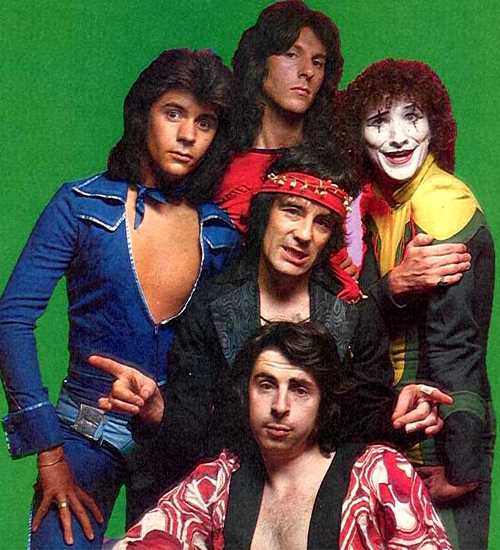
The other strand of belief is that it began in the late 70's, thanks to The Sensational Alex Harvey Band. At the time, "Delilah" had been a huge hit for Tom Jones and many bands produced and released covers. Arguably the most famous of all though is that of The Sensational Alex Harvey Band, their cover reaching number 7 in the 1975 UK charts. It is believed that, later on in the decade, the band played a gig at Stoke's former stadium, the Victoria Ground, playing the song. Stoke City played the next day and, during the game, fans began singing the song. It caught on rapidly and soon, fans from the Boothen End began changing the lyrics, resulting in what we hear today.

The Sensational Alex Harvey Band:
It was a different time....
(photo from Cool Album Of The Day)


However, the song has changed slightly since those times. Instead of people chanting "T.J.!", the crowd often makes a shushing sound, letting everyone know that the song is about to start. The lyrics have also come under scrutiny due to the explicitness, particularly the line "I put my d**k in her hands". Some people have called for them to be changed and "I put my knife in her hands" has been heard instead at some games.


Let's have a listen to the song, this time performed by fans before the FA Cup final in 2011.


Now it's time to gauge the fans' opinion. For this, seeing as I study in Stoke, I spoke to passer-byes in the Shelton area. As Stoke fans are known for being both fiercely proud and loyal to their club and it's traditions, I can see only one outcome.

Roger (54), from Stoke-on-Trent, said, "I love the song. I go to every Stoke home game and it's a pleasure to join in with. It sums us "Stokies" up well I think."

Ross (36), also from Stoke-on-Trent, agreed. He said, "I truly think we have the best traditional club song. Whilst "You'll Never Walk Alone" and other songs are more famous, none of them match the fans as well as "Delilah" does."

Dan (21), from Burton-upon-Trent, whilst admitting to being only a casual fan, said "I love it to be honest. I only go to a couple of home games a year but nothing beats when everybody begins shushing because you know what's coming. They sing it so loud as well!"

Matt (20), from Market Harborough, recalls his favourite "Delilah" memory. "Just after we lost 1-0 to Manchester City in the F.A. Cup final, all of the players came over to applaud us and we started singing it. That's the loudest I've ever heard it and it was a very emotional moment. It summed up the Stoke City spirit well.


An overwhelming yes for "Delilah" then it seems! 


That's all for this post folks! Join me in a few days for the next installment and, don't forget, if you want to agree/disagree, you can always leave a comment!

Thanks for reading!

Monday, 28 January 2013

Derby County F.C. - "Steve Bloomer's Watching"

Hello and welcome to the first "official" post of 'Songs Of The Stands'!

 Today, I'm looking at the traditional club song of my hometown team, Derby County, otherwise known as the Rams!

(Photo from The Daily Echo)


As an avid Derby County fan myself, I will try and keep this post as objective as possible but please forgive me if my bias somehow seeps in!


To understand "Steve Bloomer's Watching", we first need to look at the legendary Steve Bloomer (affectionately nicknamed the "Destroying Angel"), undoubtedly one of the best footballers to ever play the game. Truly a brilliant sportsman (he also played baseball and cricket for Derby teams), he made his professional debut at the tender age of just 18, firing home 4 goals in a game against Darley Dale. He went on to have a prolific career, including a 14-year tenure at Derby County, scoring a total of 332 goals in 525 games for the Rams. Known for having a very slight frame, he terrorised defenses with his natural skill and pure instinct for the game.

It's no surprise then that he's considered one of Derby County's biggest icons with an anthem to match. First used on Boxing Day of 1997, "Steve Bloomer's Watching" was written by 2 Derby fans (Mark Tewson and Martyn Miller) after hearing "Up There Cazaly" at an Australian Rules Football game. They re-wrote the song to include Derby's football greats whilst their musician friend Stephen Halston-Reid modernised the composition.

BBC Radio Derby and actor Robert Lindsay soon got involved after hearing the reworked song. Lionel Pickering (director), Jim Smith (manager) and several squad players also joined in to record the song under the name  'Robert Lindsay and the Pride Park Posse' (arguably the most cringeworthy band name ever).

Robert Lindsay: Leader of the "posse"
(photo from The Times)


Since then, it has been played before every single home game, allowing fans young and old to remember the greatness of Steve Bloomer, the game's first real superstar. Bloomer now sits alongside the home dug-out at Pride Park in the form of a bust, "guiding our heroes in the black and the white" as it says in the song.


Now to have a listen:


Another unique feature of this blog is that, for every song, I'll be getting the opinions of the club's fans. Because, let's face it, they're the ones who sing it week in, week out.


For "Steve Bloomer's Watching", I spoke to several people on the DCFCfans forum to gauge their opinion. Unfortunately, the responses were much more negative than I had anticipated.

Sam (17), from Derby, said "When I was younger, it was alright but I've heard it so many times now, its getting on my nerves. No-one really joins in, you just get half the ground clapping and shouting "Derby!" at the end."

James (22),, from Derby, raises the issue of when it's played: "I'm sure the song used to be played to coincide with the kick off which was better as there would be a big load of noise as the game started. Now it's played 10 mins before kick off so less people are interested in joining in and are still finishing off their pints downstairs."

Callum (17),, from Heanor, agrees: "It doesn't help how it's played ten minutes before kick off. Singing it then just feels pointless to me."

On the other hand, Dan (25),, from Blackpool, says, "I like the song & always join in! It's our song & no-one else sings it unlike some chart or old songs adopted by other clubs. It's something nice & unique to us even if the tune is a rip-off of an old Aussie song!"


As for myself, I have to agree with Dan. I find the song to be very uplifting and, just before the kick-off of an important game, it certainly gives me chills when it rings around the stadium. Take the other weekend, for example, during the passionate East Midlands derby between Derby County and Nottingham Forest. 27,000 home fans all standing and belting out "Everybody's frightened of that Derby pride!"

That, my friends, is what a football game is all about.


That brings to a close the first real post of 'Songs Of The Stands'! Thanks to all the participants who gave their opinions and I hope you stick around for the next post in a couple of days!


Tuesday, 22 January 2013

Hello!

Hello and welcome to the first post of 'Songs Of The Stands', a brand new and entirely unique blog that covers both music and football in one fell swoop!

In the coming months, I'll be looking at one of the biggest factors of the matchday experience besides the football itself. The music.

Responsible for creating the atmosphere that keeps us coming back every Saturday, the music is one of the true traditions of a football game, passed down from generation to generation to allow fans to showcase their love, not only for their team, but also for the beautiful game.

The main focus of this blog will be to look at traditional club songs, from the euphoric anthems that ring out of Anfield and Old Trafford to lesser known songs from Bramall Lane and Easter Road. All leagues will be covered in a tireless effort to find and discuss the best songs.

That's not all though, as I'll also be looking at other instances where music and football have met, including the advertising and branding of major world tournaments. I'll also be delving into the dark, and sometimes unnerving, world of footballers trying to crack the charts, often ending in embarrassment and humiliation.

Stick around and I hope you enjoy it! The first "song from the stands" will be up shortly.